
How I use Claude to learn new skills
The old way of learning things (online courses, watching videos, etc.) is completely broken.
I learn by doing, and I don’t think that’s unique.
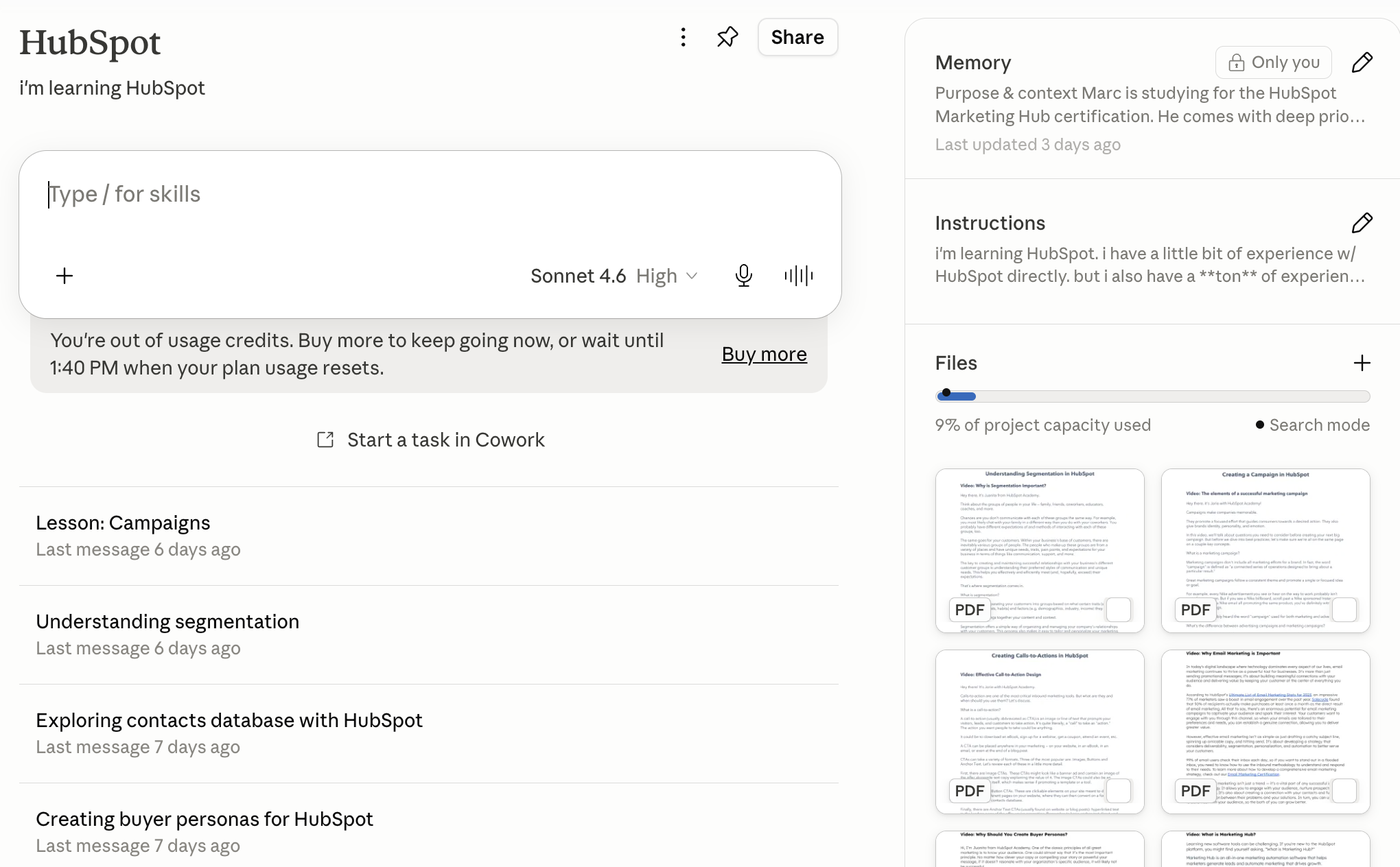
Here’s how I’m using Claude to improve my HubSpot skills using fake user & campaign data Claude created for me via HubSpot MCP.
- Create Claude Project (
HubSpot). Give it whatever context is useful (for me I said I’m more familiar w/ Pardot and Salesforce than HubSpot).- Load Project with transcripts from HubSpot Academy videos (available for most videos)
- Choose whatever lesson you want to do, eg
Key Marketing Reporting Features- Start new chat in Project
Here’s the prompt I use in that first chat:
- summarize the transcript for lesson “key reporting features” and call out any important concepts. Highlight what’s different/the same between HubSpot and Pardot
- load HubSpot w/ any relevant sample data directly (or ask me to do it if a good part of the lesson)
Claude then creates a short lesson, loads HubSpot w/ placeholder data, and generates a quiz.
I ask followup questions, answer the quiz, etc. right in the chat.
This has been working for me for a few reasons: It’s interactive so it holds my attention, it’s super tailored to me and the skills I already have, and it uses a HubSpot instance w/ realistic data.
Anyone else using AI tools to learn new things like this? What am I missing?
How I use AI to build my resume variations (it’s not what you think!)
Background
- Employers use AI to filter job candidates
- One of those filters is the extent to which a candidate’s resume matches the job description (JD)
- Thus, a best practice for applying to jobs is to tailor your resume to the JD for each role to which you apply
Options
Job seekers in 2026 have roughly 3 options.
- No AI. Manually write resume variants for each role. This is obviously time consuming for the modern job seeker applying to dozens of roles per week.
- 100% AI. A prospective employee might prompt Claude or ChatGPT to modify their resume to match a given JD. Or they might use a purpose-built tool like jobscan that does it for you.
- Hybrid between AI and my writing. This is what I do.
The hybrid approach
I don’t want to use AI to write my resume.
- I trust my own words more than Claude for something high stakes like a job application
- I don’t want to lie to companies with stuff AI made up
- I know my career the best
Step 1: All the bullets
So I made a massive (2,500 words & counting) text file called all the bullets.txt that has a list of all the things I’ve done at the four companies I’ve worked for over fifteen years, like "Planned and executed integrated sales campaign motions across events, webinars, digital ads, and email sequences"
Step 2: Claude Skill
I made a Claude Skill that does the following:
- Reads whatever JD I paste in
- Chooses the best matching bullets
- Prompts me if there’s a gap between the JD and my bullets. If there’s a gap for which I have a credible answer, it’s just not in the text file yet, I write it and instruct Claude to add to the file.
- Creates headings and places the bullets under them
- Writes a snippet draft
Conclusion
This process has been working well for me. I’m not saying I get an interview for every role to which I apply, far from it, but my hit rate is acceptable. I also feel good about this balance between using AI while keeping my integrity intact.
using claude to track my daily saturated fat intake
I have high LDL cholesterol. Not crazy high but a bit over the mark. I exercise a lot which helps but doesn’t completely overcome genetics. So I’m trying to reduce the amount of saturated fat I eat. The goal is 20 g or less per day. I’ve found this to be a great use case for Claude. Here’s why:
- Claude tracks the amount of sat fat I eat per day and week, and I don’t have to do any data entry
- Claude estimates the amount of saturated fat I’m eating in foods that don’t have a label. It may get it wrong but directionally the average is likely good enough.
- Claude maintains the running average for the week so I can stay on target.
- I add the recipes I make to the project as plain text files, so Claude can calculate serving based on the food I actually eat.
Here’s how I set it up.
1. Claude project. This has a bunch of benefits:
- Easy to find the chat
- Maintains context over time
- Give it directions once – no need to re-enter a prompt
2. Project instructions
I will give you a food. Your job is to tell me the impact on my heart health. I have high cholesterol LDL, likely familial. I also use these chats as a running log throughout the day. Marc tracks sat fat weekly with a 140g weekly budget. He wants a running weekly total, not daily, so he can save up for a cheat day.” He also wants more soluble fiber. On most days I eat 48g oatmeal (about 2-3g fiber.), target is 10g / day.
3. The chats. This is the simplest part. Each week, I start a new chat. Then I tell it what I eat every day. It keeps track like this:

I imagine this would work for other habit tracking, diets, etc.
claude design
This post from Paul Ford is an interesting perspective/thought experiment on how big AI companies may be incentivized to build more software.
Claude Design is a good example: It whips together a design in a few minutes, burning lots of tokens, but after that, you might tweak and noodle for hours, talking to the LLM much less often. During those noodling hours, you’re barely using any tokens at all. If the software is good enough and your design documents are already managed by Anthropic, you’re getting more value out of your account, and you won’t switch the moment a new, cheaper option shows up across the street. So you could think of Claude Design not as a “Figma-killer” or a “Canva-killer” but as a really cheap way to keep millions of people inside the big Claude tent.
“Cheap” is the most interesting part to me. When I look at Claude Design, I see how they took their ability to create “artifacts” and hacked together a DOM editor on top of it. It’s not a radical new step as much as a combination of different things Anthropic had already created. It probably wasn’t built in a weekend, but I’d guess the level of effort was way, way less—by an order of magnitude!—than was necessary to build Google Slides back in the day. Because of vibe coding, it’s much easier to build products than it used to be, and Anthropic already had a lot of the necessary technologies to make a “web and slide design tool.”
It’s basically a tautology that the easier software is to make, the more of it there will be. But as Paul alludes to, that doesn’t mean there’s a market, a plan to reach that market, strong differentiators, etc.
I’m not sure where it ends, but it’ll be fun to watch.
jerry paper
New EP - Jerry Paper I like this 5-song EP by Jerry Paper.
Apple Music calls him an “experimental pop musician” and I think that fits.
What is a blog in 2026
What is a blog in 2026?
I do not know.
Why do I have a blog in 2026?
I’m not sure. Except for that I’ve always had a blog, it’s a thing that’s always there, like my left foot. (And my right foot, too, I have both feet still, thankfully.)